
Planting for the Future: How One Grower is Reviving His Vineyard with Help from TVC
After six years of living near downtown in Livermore, CA, Scott Burkhart began thinking about returning to the country life he remembered from his childhood in Washington state. In the early 1990s, he and his family found what they were looking for in a modest ranch house on five acres just east of Livermore. It was surrounded by open fields and full of potential.
Not long after moving in, a neighboring winery began planting vineyards. Scott saw the opportunity. Rather than let the land sit empty, he took on a new project. He got permission to connect to a nearby waterline and, with the help of several neighbors, built a mile-long pipeline from Greenville Road to his property.
With water flowing and soil ready, Scott planted his first vines, Merlot, in 1992. When the property next door came up for sale, he took a leap and purchased 13 more acres. From 1996 through 1999, he planted additional blocks of Merlot and Cabernet Sauvignon. Each new planting helped pay for the next.
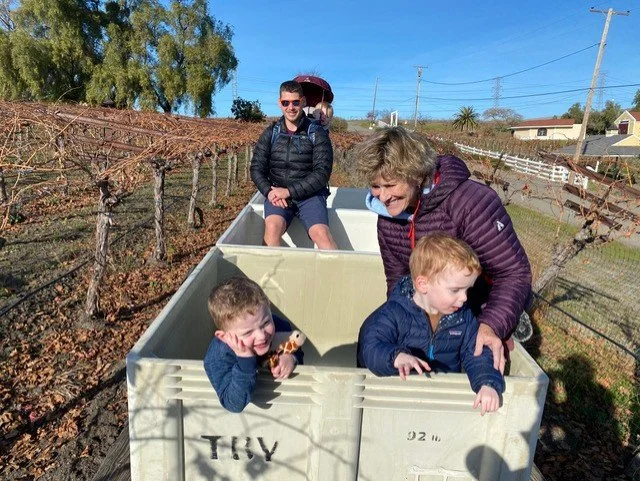
All of this happened while Scott was working full-time at Lawrence Livermore National Lab. Nights and weekends, he repaired equipment, maintained vines, and studied trellising techniques from fellow growers in Livermore and Napa Valley. He even rigged up lights on his old tractor to work after dark, much to the amusement of his wife Lisa.
Their vineyard grew, row by row and season by season, with the entire family pitching in. Even their youngest daughter helped at just five years old, walking behind Scott to mark planting spots with red plastic straws. As the children grew older, they drove tractors and worked bottling lines at local wineries. It was truly a family operation.
Now, decades later, many of those original vines are nearing the end of their lifespan. Across California, the pressures on winegrowers have grown. In the past year alone, nearly 40,000 acres of vineyard were removed due to economic hardship. In the Tri-Valley, many long-standing vineyards are facing difficult decisions.
Scott could have stepped back. Instead, he decided to move forward.
Through Tri-Valley Conservancy’s Sponsored Replanting Program, Scott secured a low-interest loan to replant eight acres of vines. He is now preparing to plant three different clones of Cabernet Franc, a varietal uniquely suited to Livermore’s terroir, along with one acre of Alvarinho, a Portuguese white grape he is excited to try for the first time.

In early 2026, Scott broke ground on replanting. His original Merlot vines, planted in 1992, and the Cabernet Sauvignon block along Greenville Road have now been removed.
The bare rows you see pictured are what remains for now.
Ahead of Scott lies a major effort: 6,000 new vines, 60 miles of wire, 6 miles of drip hose, and 12,000 emitters to install.
The first market-ready fruit from Scott’s replanting could be harvested as soon as 2029.
About TVC’s Sponsored Replanting Program
The Sponsored Replanting Program offers 15-year low-interest loans to TVC easement holders who are ready to replant or graft aging vineyard blocks.
TVC is pleased to be working on the SRPP loan program with California FarmLink, a nonprofit, certified Community Development Financial Institution (CDFI) based in Aptos, CA, dedicated exclusively to supporting farmers on land acquisition, loans, and business resilience through training and technical assistance.
This is just the first replanting loan made through the program. More applications are currently under review, and we hope to support many more growers in the coming year.
If you are a TVC easement holder considering vineyard replanting, now is the time. Please reach out to us at info@trivalleyconservancy.org for more information.